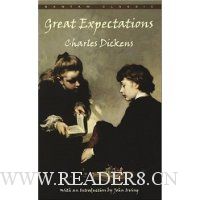
基本信息出版社:Bantam Classics
页码:560 页
出版日期:2003年05月
ISBN:0553213423
条形码:9780553213423
版本:2003-05-01
装帧:简装
开本:32开 Pages Per Sheet
外文书名:远大前程
内容简介 Book Description
In the marshy mists of a village churchyard, a tiny orphan boy named Pip is suddenly terrified by a shivering, limping convict on the run. Years later, a supremely arrogant young Pip boards the coach to London where, by the grace of a mysterious benefactor, he will join the ranks of the idle rich and "become a gentleman." Finally, in the luminous mists of the village at evening, Pip the man meets Estella, his dazzingly beautiful tormentor, in a ruined garden--and lays to rest all the heartaches and illusions that his "great expectations" have brought upon him. Dickens's biographer, Edgar H. Johnson, has said that--except for the author's last-minute tampering with his original ending--Great Expectations is "the most perfectly constructed and perfectly written of all Dickens's works." In John Irving's Introduction to this edition, the novelist takes the view that Dickens's revised ending is "far more that mirror of the quality of trust in the novel as a whole." Both versions of the ending are printed here.
Amazon.com
Dickens considered Great Expectations one of his "little pieces," and indeed, it is slim compared to such weighty novels as David Copperfield or Nicholas Nickleby. But what this cautionary tale of a young man raised high above his station by a mysterious benefactor lacks in length, it more than makes up for in its remarkable characters and compelling story. The novel begins with young orphaned Philip Pirrip--Pip--running afoul of an escaped convict in a cemetery. This terrifying personage bullies Pip into stealing food and a file for him, threatening that if he tells a soul "your heart and your liver shall be tore out, roasted and ate." The boy does as he's asked, but the convict is captured anyway, and transported to the penal colonies in Australia. Having started his novel in a cemetery, Dickens then ups the stakes and introduces his hero into the decaying household of Miss Havisham, a wealthy, half-mad woman who was jilted on her wedding day many years before and has never recovered. Pip is brought there to play with Miss Havisham's ward, Estella, a little girl who delights in tormenting Pip about his rough hands and future as a blacksmith's apprentice.
“I had never thought of being ashamed of my hands before; but I began to consider them a very indifferent pair. Her contempt for me was so strong, that it became infectious, and I caught it. ”
It is an infection that Pip never quite recovers from; as he spends more time with Miss Havisham and the tantalizing Estella, he becomes more and more discontented with his guardian, the kindhearted blacksmith, Joe, and his childhood friend Biddy. When, after several years, Pip becomes the heir of an unknown benefactor, he leaps at the chance to leave his home and friends behind to go to London and become a gentleman. But having expectations, as Pip soon learns, is a two-edged sword, and nothing is as he thought it would be. Like that other "little piece," A Tale of Two Cities, Great Expectations is different from the usual Dickensian fare: the story is dark, almost surreal at times, and you'll find few of the author's patented comic characters and no comic set pieces. And yet this is arguably the most compelling of Dickens's novels for, unlike David Copperfield or Martin Chuzzlewit, the reader can never be sure that things will work out for Pip. Even Dickens apparently had his doubts--he wrote two endings for this novel.
--Alix Wilber
From The Boston Globe, January 1999
"For classic literature, check out the new "Cover to Cover" series. All are 19th and 20th century works produced in England. They are handsomely packaged in sturdy, decorative cardboard boxes. The series carries the exclusive Royal Warrant from Charles, Prince of Wales."
From Dick Richmond, St. Louis Post-Dispatch, November 1998
"Anyone who listens to audio books on a regular basis inevitably settles on favorite readers. While most are good, only a few are consistently outstanding. Regarding this production, this was only my second experience with Martin Jarvis as the narrator. To call his performance here brilliant would be to understate the case. If ever a single narrator sounded like an entire cast of distinctive personalities, this is it. So when Pip, Joe Gargery, Mrs. Joe, Mr. Pumblechook, Miss Havisham, Biddy, lawyer Jaggers, Abel Magwitch or Herbert Pocket are speaking, you know exactly who they are as well as their attitudes. Even some of the lesser players emerge three-dimensional, creating images in your mind as vivid as some of the characters in the movies before panoramic screens substituted width for depth in stories being filmed...Pip and the individuals who shape his life are engrossing enough to become habit-forming, even those you may have the urge to slap. You will want to keep this one."
From AudioFile
Great literature can pose problems for narrators. If the book is a classic, the pitfalls are that the listener has a preconceived notion of how the book should sound and, perhaps, how the characters themselves should sound. It is, thus, heartening to listen to Michael Page's narration of Dickens's tale. He sheds new light on the text and shows off his collection of personalities and voices. Page twists his English accent so that the characters have their own unique inflections, laughs and resonance. His voice is slightly nasal but full. He's exceptionally good at setting the tone of this rather wistful novel. And his marvelous diction and pacing make the story vibrant and interesting. R.I.G.
The Merriam-Webster Encyclopedia of Literature
Novel by Charles Dickens, first published serially in All the Year Round in 1860-61 and issued in book form in 1861. The novel was one of its author's greatest critical and popular successes. The first-person narrative relates the coming-of-age of Pip (Philip Pirrip). Reared in the marshes of Kent by his disagreeable sister and her sweet-natured husband, the blacksmith Joe Gargery, the young Pip one day helps a convict to escape. Later he is sent to live with Miss Havisham, a woman driven half-mad years earlier by her lover's departure on their wedding day. Her other ward is the orphaned Estella, whom she is teaching to torment men with her beauty. Pip, at first cautious, later falls in love with Estella, to his misfortune. When an anonymous benefactor makes it possible for Pip to go to London for an education, he credits Miss Havisham. He begins to look down on his humble roots, but nonetheless Estella spurns him again and marries instead the ill-tempered Bentley Drummle. Pip's benefactor turns out to have been Abel Magwitch, the convict he once aided, who dies awaiting trial after Pip is unable to help him a second time. Joe rescues Pip from despair and nurses him back to health.
More About the Author
Charles Dickens was born on February 7, 1812, in Portsmouth, England,where his father was a naval pay clerk. When he was five the family moved to Chatham, near Rochester, another port town. He received some education at a small private school but this was curtailed when his father's fortunes declined. More significant was his childhood reading, which he evoked in a memory of his father's library: 'From that blessed little room, Roderick Random, Peregrine Pickle, Humphrey Clinker, Tom Jones, The Vicar of Wakefield, Don Quixote, Gil Blas and Robinson Crusoe came out, a glorious host, to keep me company. They kept alive my fancy, and my hope of something beyond that place and time.'
When Dickens was ten the family moved to Camden Town, and this proved the beginning of a long, difficult period. (He wrote later of his coach journey, alone, to join his family at the new lodgings: 'I consumed my sandwiches in solitude and dreariness, and it rained hard all the way, and I thought life sloppier than I had expected to find it.') When he had just turned twelve Dickens was sent to work for a manufacturer of boot blacking, where for the better part of a year he labored for ten hours a day, an unhappy experience that instilled him with a sense of having been abandoned by his family: 'No advice, no counsel, no encouragement, no consolation, no support from anyone that I can call to mind, so help me God!' Around the same time Dickens's father was jailed for debt in the Marshalsea Prison, where he remained for fourteen weeks. After some additional schooling, Dickens worked as a clerk in a law office and taught himself shorthand; this qualified him to begin working in 1831 as a reporter in the House of Commons, where he was known for the speed with which he took down speeches.
By 1833 Dickens was publishing humorous sketches of London life in the Monthly Magazine, which were collected in book form as Sketches by 'Boz' (1836). These were followed by the publication in installments of the comic adventures that became The Posthumous Papers of the Pickwick Club (1837), whose unprecedented popularity made the twenty-five-year-old author a national figure. In 1836 he married Catherine Hogarth, who would bear him ten children over a period of fifteen years. Dickens's energies enabled him to lead an active family and social life, including an indulgence in elaborate amateur theatricals, while maintaining a literary productiveness of astonishing proportions. He characteristically wrote his novels for serial publication, and was himself the editor of many of the periodicals—Bentley's Miscellany, The Daily News, Household Words, All the Year Round—in which they appeared. Among his close associates were his future biographer John Forster and the younger Wilkie Collins, with whom he collaborated on fictional and dramatic works. In rapid succession he published Oliver Twist (1838), Nicholas Nickleby (1839), The Old Curiosity Shop (1841), and Barnaby Rudge (1841), sometimes working on several novels simultaneously.
Dickens's celebrity led to a tour of the United States in 1842. There he met Longfellow, Irving, Bryant, and other literary figures, and was received with an enthusiasm that was dimmed somewhat by the criticisms Dickens expressed in his American Notes (1842) and in the American chapters of Martin Chuzzlewit (1844). The appearance of A Christmas Carol in 1843 sealed his position as the most widely popular writer of his time; it became an annual tradition for him to write a story for the season, of which the most memorable were The Chimes (1844) and The Cricket on the Hearth (1845). He continued to produce novels at only a slightly diminished rate, publishing Dombey and Son in 1848 and David Copperfield in 1850; of the latter, his personal favorite among his books, he wrote to Forster: 'If I were to say half of what Copperfield makes me feel tonight how strangely, even to you, I should be turned inside out! I seem to be sending some part of myself into the Shadowy World.'
From this point on his novels tended to be more elaborately constructed and harsher and less buoyant in tone than his earlier works. These late novels include Bleak House (1853), Hard Times (1854), Little Dorrit (1857), A Tale of Two Cities (1859), and Great Expectations (1861). Our Mutual Friend, published in 1865, was his last completed novel, and perhaps the most somber and savage of them all. Dickens had separated from his wife in 1858—he had become involved a year earlier with a young actress named Ellen Ternan—and the ensuing scandal had alienated him from many of his former associates and admirers. He was weakened by years of overwork and by a near-fatal railroad disaster during the writing of Our Mutual Friend. Nevertheless he embarked on a series of public readings, including a return visit to America in 1867, which further eroded his health. A final work, The Mystery of Edwin Drood, a crime novel much influenced by Wilkie Collins, was left unfinished upon his death on June 9,1870, at the age of 58.
Book Dimension :
length: (cm)17 width:(cm)12.9
作者简介 Charles Dickens was born on February 7, 1812, in Portsmouth, England,where his father was a naval pay clerk. When he was five the family moved to Chatham, near Rochester, another port town. He received some education at a small private school but this was curtailed when his father's fortunes declined. More significant was his childhood reading, which he evoked in a memory of his father's library: 'From that blessed little room, Roderick Random, Peregrine Pickle, Humphrey Clinker, Tom Jones, The Vicar of Wakefield, Don Quixote, Gil Blas and Robinson Crusoe came out, a glorious host, to keep me company. They kept alive my fancy, and my hope of something beyond that place and time.'