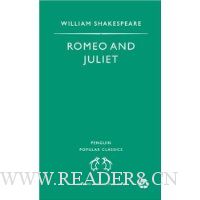
基本信息出版社:Penguin Classics
页码:160 页
出版日期:1994年06月
ISBN:0140620931
条形码:9780140620931
版本:New Ed
装帧:平装
正文语种:英语
丛书名:Penguin Popular Classics
外文书名:罗密欧与朱丽叶
内容简介 A young man and woman meet by chance and fall instantly in love. But their families are bitter enemies, and in order to be together, the two lovers must be prepared to risk everything. Set in a city torn apart by feuds and gang warfare, "Romeo and Juliet" is a dazzling combination of passion and hatred, bawdy comedy and high tragedy.
作者简介 William Shakespeare was an English poet and playwright of the 16th and 17 centuries, now widely regarded as the greatest writer in the English language and the word's pre-eminent dramatist.
编辑推荐 Amazon.co.uk Review
This is undoubtedly the greatest love story ever written, spawning a host of imitators on stage and screen, including Leonard Bernstein's smash musical West Side Story, Franco Zeffirelli's Romeo and Juliet filmed in 1968, and Baz Luhrmann's postmodern film version Romeo + Juliet. The tragic feud between "Two households, both alike in dignity/In fair Verona", the Montagues and Capulets, which ultimately kills the two young "star-crossed lovers" and their "death-marked love" creates issues which have fascinated subsequent generations. The play deals with issues of intergenerational and familial conflict, as well as the power of language and the compelling relationship between sex and death, all of which makes it an incredibly modern play. It is also an early example of Shakespeare fusing poetry with dramatic action, as he moves from Romeo's lyrical account of Juliet--"she doth teach the torches to burn bright!" to the bustle and action of a 16th-century household (the play contains more scenes of ordinary working people than any of Shakespeare's other works). It also represents an experimental attempt to fuse comedy with tragedy. Up to the third act, the play proceeds along the lines of a classic romantic comedy. The turning point comes with the death of one of Shakespeare's finest early dramatic creations--Romeo's sexually ambivalent friend Mercutio, whose "plague o' both your houses" begins the play's descent into tragedy, "For never was a story of more woe/Than this of Juliet and her Romeo". --Jerry Brotton