关于web渗透中得一些记录
1. 当得到linux root shell时,采用如下语句可以添加管理员帐户
??写道
?这个比较方便
?
?
3. ssh端口转发代理,这个作用大家都懂的
? ? ?第一种可以利用windows下的客户端例如securCRT中的
? ? ? ? ? session options中得Port Forwarding
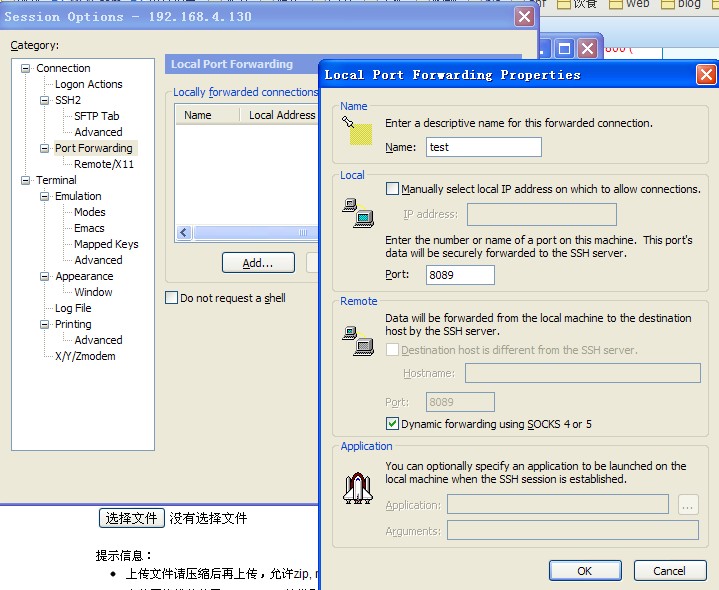
第二种就是自己手动命令了
? ? ??http://7056824.blog.51cto.com/69854/279714
这篇大致讲的还是蛮细的。
基本上就是
#! /usr/bin/env python#coding=utf-8import socket, sys, select, SocketServer, struct, timeclass ThreadingTCPServer(SocketServer.ThreadingMixIn, SocketServer.TCPServer): passclass Socks5Server(SocketServer.StreamRequestHandler): def handle_tcp(self, sock, remote): fdset = [sock, remote] while True: r, w, e = select.select(fdset, [], []) if sock in r: if remote.send(sock.recv(4096)) <= 0: break if remote in r: if sock.send(remote.recv(4096)) <= 0: break def handle(self): try: print 'socks connection from ', self.client_address sock = self.connection # 1. Version sock.recv(262) sock.send(b"\x05\x00"); # 2. Request data = self.rfile.read(4) mode = ord(data[1]) addrtype = ord(data[3]) if addrtype == 1: # IPv4 addr = socket.inet_ntoa(self.rfile.read(4)) elif addrtype == 3: # Domain name addr = self.rfile.read(ord(sock.recv(1)[0])) port = struct.unpack('>H', self.rfile.read(2)) reply = b"\x05\x00\x00\x01" try: if mode == 1: # 1. Tcp connect remote = socket.socket(socket.AF_INET, socket.SOCK_STREAM) remote.connect((addr, port[0])) print 'Tcp connect to', addr, port[0] else: reply = b"\x05\x07\x00\x01" # Command not supported local = remote.getsockname() reply += socket.inet_aton(local[0]) + struct.pack(">H", local[1]) except socket.error: # Connection refused reply = '\x05\x05\x00\x01\x00\x00\x00\x00\x00\x00' sock.send(reply) # 3. Transfering if reply[1] == '\x00': # Success if mode == 1: # 1. Tcp connect self.handle_tcp(sock, remote) except socket.error: print 'socket error'def main(): server = ThreadingTCPServer(('', 2013), Socks5Server) server.serve_forever()if __name__ == '__main__': main()??
http 代理
# -*- coding: cp1252 -*-# <PythonProxy.py>##Copyright (c) <2009> <Fábio Domingues - fnds3000 in gmail.com>##Permission is hereby granted, free of charge, to any person#obtaining a copy of this software and associated documentation#files (the "Software"), to deal in the Software without#restriction, including without limitation the rights to use,#copy, modify, merge, publish, distribute, sublicense, and/or sell#copies of the Software, and to permit persons to whom the#Software is furnished to do so, subject to the following#conditions:##The above copyright notice and this permission notice shall be#included in all copies or substantial portions of the Software.##THE SOFTWARE IS PROVIDED "AS IS", WITHOUT WARRANTY OF ANY KIND,#EXPRESS OR IMPLIED, INCLUDING BUT NOT LIMITED TO THE WARRANTIES#OF MERCHANTABILITY, FITNESS FOR A PARTICULAR PURPOSE AND#NONINFRINGEMENT. IN NO EVENT SHALL THE AUTHORS OR COPYRIGHT#HOLDERS BE LIABLE FOR ANY CLAIM, DAMAGES OR OTHER LIABILITY,#WHETHER IN AN ACTION OF CONTRACT, TORT OR OTHERWISE, ARISING#FROM, OUT OF OR IN CONNECTION WITH THE SOFTWARE OR THE USE OR#OTHER DEALINGS IN THE SOFTWARE."""\Copyright (c) <2009> <Fábio Domingues - fnds3000 in gmail.com> <MIT Licence> ************************************** *** Python Proxy - A Fast HTTP proxy *** **************************************Neste momento este proxy é um Elie Proxy.Suporta os métodos HTTP: - OPTIONS; - GET; - HEAD; - POST; - PUT; - DELETE; - TRACE; - CONENCT.Suporta: - Conex?es dos cliente em IPv4 ou IPv6; - Conex?es ao alvo em IPv4 e IPv6; - Conex?es todo o tipo de transmiss?o de dados TCP (CONNECT tunneling), p.e. liga??es SSL, como é o caso do HTTPS.A fazer: - Verificar se o input vindo do cliente está correcto; - Enviar os devidos HTTP erros se n?o, ou simplesmente quebrar a liga??o; - Criar um gestor de erros; - Criar ficheiro log de erros; - Colocar excep??es nos sítios onde é previsível a ocorrência de erros, p.e.sockets e ficheiros; - Rever tudo e melhorar a estrutura do programar e colocar nomes adequados nas variáveis e métodos; - Comentar o programa decentemente; - Doc Strings.Funcionalidades futuras: - Adiconar a funcionalidade de proxy anónimo e transparente; - Suportar FTP?.(!) Aten??o o que se segue só tem efeito em conex?es n?o CONNECT, para estas o proxy é sempre Elite.Qual a diferen?a entre um proxy Elite, Anónimo e Transparente? - Um proxy elite é totalmente anónimo, o servidor que o recebe n?o consegue ter conhecimento da existência do proxy e n?o recebe o endere?o IP do cliente; - Quando é usado um proxy anónimo o servidor sabe que o cliente está a usar um proxy mas n?o sabe o endere?o IP do cliente; é enviado o cabe?alho HTTP "Proxy-agent". - Um proxy transparente fornece ao servidor o IP do cliente e um informa??o que se está a usar um proxy. S?o enviados os cabe?alhos HTTP "Proxy-agent" e "HTTP_X_FORWARDED_FOR"."""import socket, thread, select__version__ = '0.1.0 Draft 1'BUFLEN = 8192VERSION = 'Python Proxy/'+__version__HTTPVER = 'HTTP/1.1'class ConnectionHandler: def __init__(self, connection, address, timeout): self.client = connection self.client_buffer = '' self.timeout = timeout self.method, self.path, self.protocol = self.get_base_header() if self.method=='CONNECT': self.method_CONNECT() elif self.method in ('OPTIONS', 'GET', 'HEAD', 'POST', 'PUT', 'DELETE', 'TRACE'): self.method_others() self.client.close() self.target.close() def get_base_header(self): while 1: self.client_buffer += self.client.recv(BUFLEN) end = self.client_buffer.find('\n') if end!=-1: break print '%s'%self.client_buffer[:end]#debug data = (self.client_buffer[:end+1]).split() self.client_buffer = self.client_buffer[end+1:] return data def method_CONNECT(self): self._connect_target(self.path) self.client.send(HTTPVER+' 200 Connection established\n'+ 'Proxy-agent: %s\n\n'%VERSION) self.client_buffer = '' self._read_write() def method_others(self): self.path = self.path[7:] i = self.path.find('/') host = self.path[:i] path = self.path[i:] self._connect_target(host) self.target.send('%s %s %s\n'%(self.method, path, self.protocol)+ self.client_buffer) self.client_buffer = '' self._read_write() def _connect_target(self, host): i = host.find(':') if i!=-1: port = int(host[i+1:]) host = host[:i] else: port = 80 (soc_family, _, _, _, address) = socket.getaddrinfo(host, port)[0] self.target = socket.socket(soc_family) self.target.connect(address) def _read_write(self): time_out_max = self.timeout/3 socs = [self.client, self.target] count = 0 while 1: count += 1 (recv, _, error) = select.select(socs, [], socs, 3) if error: break if recv: for in_ in recv: data = in_.recv(BUFLEN) if in_ is self.client: out = self.target else: out = self.client if data: out.send(data) count = 0 if count == time_out_max: breakdef start_server(host='localhost', port=8082, IPv6=False, timeout=60, handler=ConnectionHandler): if IPv6==True: soc_type=socket.AF_INET6 else: soc_type=socket.AF_INET soc = socket.socket(soc_type) soc.bind((host, port)) print "Serving on %s:%d."%(host, port)#debug soc.listen(0) while 1: thread.start_new_thread(handler, soc.accept()+(timeout,))if __name__ == '__main__': start_server(host='',port=8082)?
4 第四个其实是mysql udf提权,有空再写吧