内存对齐的原理,作用,例子以及一些规划(中英文说明,适用sizeof结构体)
题记 下面的文章中是我对四个博客文章的合成,非原创,解释了内存对齐的原因,作用(中英文说明),及其规划!尤其适用于对sizeof结构体。首先解释了内存对齐的原理,然后对作用进行了说明,最后是例子!其中中文对内存对齐,原作者做了详细的说明及其例子解释,需要注意的是,如struct{ char?a; int?b; char?b}A;a在分配时候占用其中一个字节,剩下3个,但是b分配的是4字节,明显3个字节无法满足,那么就需要另外写入队列人觉得第二个中文作者(按我最后说明博客地址顺序)提到的最重要的是画图是一个很不错的方法.?我在引用的第四个博客中,也就是最后的博客中,通过详细的代码解释,说明了内存对齐的规划问题!?内存对齐在系统或驱动级别以至于高真实时,高保密的程序开发的时候,程序内存分配问题仍旧是保证整个程序稳定,安全,高效的基础。所以对内存对齐需要学会掌握!至少在CSDN能说的来头!
? 文章可能很杂,如果看不懂,可以直接浏览中文部分,虽然我的博客很少人来看。? ? ? ? ? ? ? ? ? ? ? ? ? ? ? ? ? ? ? ? ? ? ? ? ? ? ? ? ? ? ? ? --QQ124045670
?一?? ? 内存读取粒度? ? ? ??Memory access granularity ?从内存的角度解释内存对齐的原理
Programmers are conditioned to think of memory as a simple array of bytes. Among C and its descendants,?char*?is ubiquitous as meaning "a block of memory", and even Java? has its?byte[]?type to represent raw memory.
Figure 1. How programmers see memory

However, your computer's processor does not read from and write to memory in byte-sized chunks. Instead, it accesses memory in two-, four-, eight- 16- or even 32-byte chunks. We'll call the size in which a processor accesses memory its?memory access granularity.
Figure 2. How processors see memory

The difference between how high-level programmers think of memory and how modern processors actually work with memory raises interesting issues that this article explores.
If you don't understand and address alignment issues in your software, the following scenarios, in increasing order of severity, are all possible:
- Your software will run slower.
- Your application will lock up.
- Your operating system will crash.
- Your software will silently fail, yielding incorrect results.
队列原理?Alignment fundamentals
To illustrate the principles behind alignment, examine a constant task, and how it's affected by a processor's memory access granularity. The task is simple: first read four bytes from address 0 into the processor's register. Then read four bytes from address 1 into the same register.
First examine what would happen on a processor with a one-byte memory access granularity:
Figure 3. Single-byte memory access granularity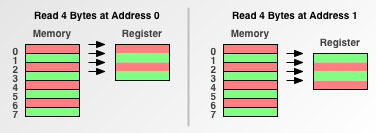
This fits in with the naive programmer's model of how memory works: it takes the same four memory accesses to read from address 0 as it does from address 1. Now see what would happen on a processor with two-byte granularity, like the original 68000:
Figure 4. Double-byte memory access granularity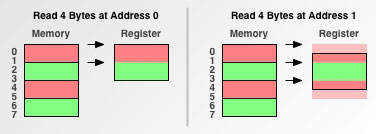
When reading from address 0, a processor with two-byte granularity takes half the number of memory accesses as a processor with one-byte granularity. Because each memory access entails a fixed amount overhead, minimizing the number of accesses can really help performance.
However, notice what happens when reading from address 1. Because the address doesn't fall evenly on the processor's memory access boundary, the processor has extra work to do. Such an address is known as an?unaligned address. Because address 1 is unaligned, a processor with two-byte granularity must perform an extra memory access, slowing down the operation.
Finally, examine what would happen on a processor with four-byte memory access granularity, like the 68030 or PowerPC? 601:
Figure 5. Quad-byte memory access granularity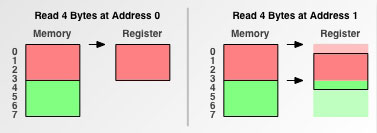
A processor with four-byte granularity can slurp up four bytes from an aligned address with one read. Also note that reading from an unaligned address doubles the access count.
Now that you understand the fundamentals behind aligned data access, you can explore some of the issues related to alignment.
Lazy processors
A processor has to perform some tricks when instructed to access an unaligned address. Going back to the example of reading four bytes from address 1 on a processor with four-byte granularity, you can work out exactly what needs to be done:
Figure 6. How processors handle unaligned memory access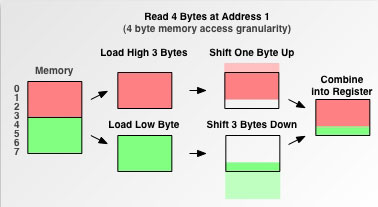
The processor needs to read the first chunk of the unaligned address and shift out the "unwanted" bytes from the first chunk. Then it needs to read the second chunk of the unaligned address and shift out some of its information. Finally, the two are merged together for placement in the register. It's a lot of work.
Some processors just aren't willing to do all of that work for you.
The original 68000 was a processor with two-byte granularity and lacked the circuitry to cope with unaligned addresses. When presented with such an address, the processor would throw an exception. The original Mac OS didn't take very kindly to this exception, and would usually demand the user restart the machine. Ouch.
Later processors in the 680x0 series, such as the 68020, lifted this restriction and performed the necessary work for you. This explains why some old software that works on the 68020 crashes on the 68000. It also explains why, way back when, some old Mac coders initialized pointers with odd addresses. On the original Mac, if the pointer was accessed without being reassigned to a valid address, the Mac would immediately drop into the debugger. Often they could then examine the calling chain stack and figure out where the mistake was.
All processors have a finite number of transistors to get work done. Adding unaligned address access support cuts into this "transistor budget." These transistors could otherwise be used to make other portions of the processor work faster, or add new functionality altogether.
An example of a processor that sacrifices unaligned address access support in the name of speed is MIPS. MIPS is a great example of a processor that does away with almost all frivolity in the name of getting real work done faster.
The PowerPC takes a hybrid approach. Every PowerPC processor to date has hardware support for unaligned 32-bit integer access. While you still pay a performance penalty for unaligned access, it tends to be small.
On the other hand, modern PowerPC processors lack hardware support for unaligned 64-bit floating-point access. When asked to load an unaligned floating-point number from memory, modern PowerPC processors will throw an exception and have the operating system perform the alignment chores?in software. Performing alignment in software is?much?slower than performing it in hardware.
二 速度 Speed (内存对齐的基本原理)
内存对齐有一个好处是提高访问内存的速度,因为在许多数据结构中都需要占用内存,在很多系统中,要求内存分配的时候要对齐.下面是对为什么可以提高内存速度通过代码做了解释!
代码解释?Writing some tests illustrates the performance penalties of unaligned memory access. The test is simple: you read, negate, and write back the numbers in a ten-megabyte buffer. These tests have two variables:
- The size, in bytes, in which you process the buffer.?First you'll process the buffer one byte at a time. Then you'll move onto two-, four- and eight-bytes at a time.
- The alignment of the buffer.?You'll stagger the alignment of the buffer by incrementing the pointer to the buffer and running each test again.
These tests were performed on a 800 MHz PowerBook G4. To help normalize performance fluctuations from interrupt processing, each test was run ten times, keeping the average of the runs. First up is the test that operates on a single byte at a time:
Listing 1. Munging data one byte at a timevoid Munge8( void *data, uint32_t size ) { uint8_t *data8 = (uint8_t*) data; uint8_t *data8End = data8 + size; while( data8 != data8End ) { *data8++ = -*data8; }}It took an average of 67,364 microseconds to execute this function. Now modify it to work on two bytes at a time instead of one byte at a time -- which will halve the number of memory accesses:
Listing 2. Munging data two bytes at a timevoid Munge16( void *data, uint32_t size ) { uint16_t *data16 = (uint16_t*) data; uint16_t *data16End = data16 + (size >> 1); /* Divide size by 2. */ uint8_t *data8 = (uint8_t*) data16End; uint8_t *data8End = data8 + (size & 0x00000001); /* Strip upper 31 bits. */ while( data16 != data16End ) { *data16++ = -*data16; } while( data8 != data8End ) { *data8++ = -*data8; }}This function took 48,765 microseconds to process the same ten-megabyte buffer -- 38% faster than Munge8. However, that buffer was aligned. If the buffer is unaligned, the time required increases to 66,385 microseconds -- about a 27% speed penalty. The following chart illustrates the performance pattern of aligned memory accesses versus unaligned accesses:
Figure 7. Single-byte access versus double-byte access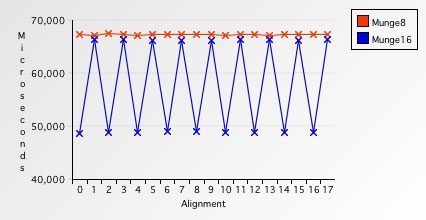
The first thing you notice is that accessing memory one byte at a time is uniformly slow. The second item of interest is that when accessing memory two bytes at a time, whenever the address is not evenly divisible by two, that 27% speed penalty rears its ugly head.
Now up the ante, and process the buffer four bytes at a time:
Listing 3. Munging data four bytes at a timevoid Munge16( void *data, uint32_t size ) { uint16_t *data16 = (uint16_t*) data; uint16_t *data16End = data16 + (size >> 1); /* Divide size by 2. */ uint8_t *data8 = (uint8_t*) data16End; uint8_t *data8End = data8 + (size & 0x00000001); /* Strip upper 31 bits. */ while( data16 != data16End ) { *data16++ = -*data16; } while( data8 != data8End ) { *data8++ = -*data8; }}This function processes an aligned buffer in 43,043 microseconds and an unaligned buffer in 55,775 microseconds, respectively. Thus, on this test machine, accessing unaligned memory four bytes at a time is?slower?than accessing aligned memory two bytes at a time:
Figure 8. Single- versus double- versus quad-byte access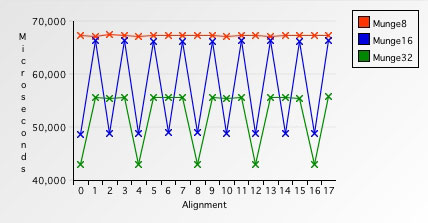
Now for the horror story: processing the buffer eight bytes at a time.
Listing 4. Munging data eight bytes at a timevoid Munge32( void *data, uint32_t size ) { uint32_t *data32 = (uint32_t*) data; uint32_t *data32End = data32 + (size >> 2); /* Divide size by 4. */ uint8_t *data8 = (uint8_t*) data32End; uint8_t *data8End = data8 + (size & 0x00000003); /* Strip upper 30 bits. */ while( data32 != data32End ) { *data32++ = -*data32; } while( data8 != data8End ) { *data8++ = -*data8; }}Munge64?processes an aligned buffer in 39,085 microseconds -- about 10% faster than processing the buffer four bytes at a time. However, processing an unaligned buffer takes an amazing 1,841,155 microseconds -- two orders of magnitude slower than aligned access, an outstanding 4,610% performance penalty!What happened? Because modern PowerPC processors lack hardware support for unaligned floating-point access, the processor throws an exception?for each unaligned access.?The operating system catches this exception and performs the alignment in software. Here's a chart illustrating the penalty, and when it occurs:
Figure 9. Multiple-byte access comparison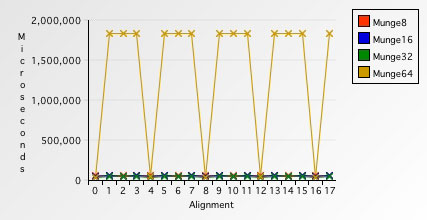
The penalties for one-, two- and four-byte unaligned access are dwarfed by the horrendous unaligned eight-byte penalty. Maybe this chart, removing the top (and thus the tremendous gulf between the two numbers), will be clearer:
Figure 10. Multiple-byte access comparison #2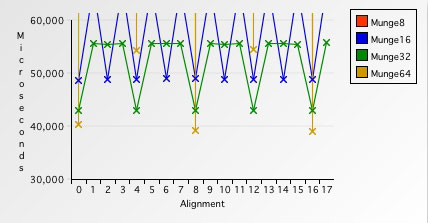
There's another subtle insight hidden in this data. Compare eight-byte access speeds on four-byte boundaries:
Figure 11. Multiple-byte access comparison #3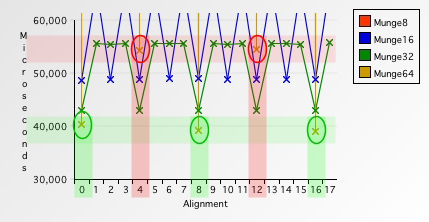
Notice accessing memory eight bytes at a time on four- and twelve- byte boundaries?is slower?than reading the same memory four or even two bytes at a time. While PowerPCs have hardware support for four-byte aligned eight-byte doubles, you still pay a performance penalty if you use that support. Granted, it's no where near the 4,610% penalty, but it's certainly noticeable. Moral of the story: accessing memory in large chunks can be slower than accessing memory in small chunks, if that access is not aligned.
Atomicity
All modern processors offer atomic instructions. These special instructions are crucial for synchronizing two or more concurrent tasks. As the name implies, atomic instructions must be?indivisible?-- that's why they're so handy for synchronization: they can't be preempted.
It turns out that in order for atomic instructions to perform correctly, the addresses you pass them must be at least four-byte aligned. This is because of a subtle interaction between atomic instructions and virtual memory.
If an address is unaligned, it requires at least two memory accesses. But what happens if the desired data spans two pages of virtual memory? This could lead to a situation where the first page is resident while the last page is not. Upon access, in the middle of the instruction, a page fault would be generated, executing the virtual memory management swap-in code, destroying the atomicity of the instruction. To keep things simple and correct, both the 68K and PowerPC require that atomically manipulated addresses always be at least four-byte aligned.
Unfortunately, the PowerPC does not throw an exception when atomically storing to an unaligned address. Instead, the store simply always fails. This is bad because most atomic functions are written to retry upon a failed store, under the assumption they were preempted. These two circumstances combine to where your program will go into an infinite loop if you attempt to atomically store to an unaligned address. Oops.
Altivec
Altivec is all about speed. Unaligned memory access slows down the processor and costs precious transistors. Thus, the Altivec engineers took a page from the MIPS playbook and simply don't support unaligned memory access. Because Altivec works with sixteen-byte chunks at a time, all addresses passed to Altivec must be sixteen-byte aligned. What's scary is what happens if your address is not aligned.
Altivec won't throw an exception to warn you about the unaligned address. Instead, Altivec simply ignores the lower four bits of the address and charges ahead,?operating on the wrong address. This means your program may silently corrupt memory or return incorrect results if you don't explicitly make sure all your data is aligned.
There is an advantage to Altivec's bit-stripping ways. Because you don't need to explicitly truncate (align-down) an address, this behavior can save you an instruction or two when handing addresses to the processor.
This is not to say Altivec can't process unaligned memory. You can find detailed instructions how to do so on the?Altivec Programming Environments Manual?(see?Resources). It requires more work, but because memory is so slow compared to the processor, the overhead for such shenanigans is surprisingly low.
Structure alignment
Examine the following structure:
Listing 5. An innocent structure?
void Munge64( void *data, uint32_t size ) {
typedef struct {
? ? char ? ?a;
? ? long ? ?b;
? ? char ? ?c;
} ? Struct;What is the size of this structure in bytes? Many programmers will answer "6 bytes." It makes sense: one byte for?
Field TypeField NameField OffsetField SizeField Enda, four bytes forb?and another byte for?c. 1 + 4 + 1 equals 6. Here's how it would lay out in memory:chara011longb145charc516Total Size in Bytes:6However, if you were to ask your compiler to?
sizeof( Struct ), chances are the answer you'd get back would be greater than six, perhaps eight or even twenty-four. There's two reasons for this: backwards compatibility and efficiency.First, backwards compatibility. Remember the 68000 was a processor with two-byte memory access granularity, and would throw an exception upon encountering an odd address. If you were to read from or write to field?
b, you'd attempt to access an odd address. If a debugger weren't installed, the old Mac OS would throw up a System Error dialog box with one button: Restart. Yikes!So, instead of laying out your fields just the way you wrote them, the compiler?padded?the structure so that?
Field TypeField NameField OffsetField SizeField Endb?and?c?would reside at even addresses:chara011padding112longb246charc617padding718Total Size in Bytes:8Padding is the act of adding otherwise unused space to a structure to make fields line up in a desired way. Now, when the 68020 came out with built-in hardware support for unaligned memory access, this padding was unnecessary. However, it didn't hurt anything, and it even helped a little in performance.
The second reason is efficiency. Nowadays, on PowerPC machines, two-byte alignment is nice, but four-byte or eight-byte is better. You probably don't care anymore that the original 68000 choked on unaligned structures, but you probably care about potential 4,610% performance penalties, which can happen if a?
中文代码及其内存解释double?field doesn't sit aligned in a structure of your devising.内存对齐关键是需要画图!在下面的中文有说明例子
Examine the following structure:
如果英文看不懂,那么可以直接用中文例如(http://www.cppblog.com/snailcong/archive/2009/03/16/76705.html)来说!
首先由一个程序引入话题:
?1 //环境:vc6 + windows sp2?2 //程序1?3 #include <iostream>?4??5 using namespace std;?6??7 struct st1??8 {?9 ? ? char a ;10 ? ? int ?b ;11 ? ? short c ;12 };13?14 struct st215 {16 ? ? short c ;17 ? ? char ?a ;18 ? ? int ? b ;19 };20?21 int main()22 {23 ? ? cout<<"sizeof(st1) is "<<sizeof(st1)<<endl;24 ? ? cout<<"sizeof(st2) is "<<sizeof(st2)<<endl;25 ? ? return 0 ;26 }27?
程序的输出结果为:
?sizeof(st1) is 12? ? ? ? sizeof(st2) is 8?
?
问题出来了,这两个一样的结构体,为什么sizeof的时候大小不一样呢?
本文的主要目的就是解释明白这一问题。
?
内存对齐,正是因为内存对齐的影响,导致结果不同。
对于大多数的程序员来说,内存对齐基本上是透明的,这是编译器该干的活,编译器为程序中的每个数据单元安排在合适的位置上,从而导致了相同的变量,不同声明顺序的结构体大小的不同。
?
? ? ? ?那么编译器为什么要进行内存对齐呢?程序1中结构体按常理来理解sizeof(st1)和sizeof(st2)结果都应该是7,4(int) + 2(short) + 1(char) = 7 。经过内存对齐后,结构体的空间反而增大了。
在解释内存对齐的作用前,先来看下内存对齐的规则:
1、 ?对于结构的各个成员,第一个成员位于偏移为0的位置,以后每个数据成员的偏移量必须是min(#pragma pack()指定的数,这个数据成员的自身长度) 的倍数。
2、 ?在数据成员完成各自对齐之后,结构(或联合)本身也要进行对齐,对齐将按照#pragma pack指定的数值和结构(或联合)最大数据成员长度中,比较小的那个进行。
?
#pragma pack(n) 表示设置为n字节对齐。 VC6默认8字节对齐
以程序1为例解释对齐的规则 :
St1 :char占一个字节,起始偏移为0 ,int 占4个字节,min(#pragma pack()指定的数,这个数据成员的自身长度) = 4(VC6默认8字节对齐),所以int按4字节对齐,起始偏移必须为4的倍数,所以起始偏移为4,在char后编译器会添加3个字节的额外字节,不存放任意数据。short占2个字节,按2字节对齐,起始偏移为8,正好是2的倍数,无须添加额外字节。到此规则1的数据成员对齐结束,此时的内存状态为:
oxxx|oooo|oo
0123 4567 89 (地址)
(x表示额外添加的字节)
共占10个字节。还要继续进行结构本身的对齐,对齐将按照#pragma pack指定的数值和结构(或联合)最大数据成员长度中,比较小的那个进行,st1结构中最大数据成员长度为int,占4字节,而默认的#pragma pack 指定的值为8,所以结果本身按照4字节对齐,结构总大小必须为4的倍数,需添加2个额外字节使结构的总大小为12 。此时的内存状态为:
oxxx|oooo|ooxx
0123 4567 89ab ?(地址)
到此内存对齐结束。St1占用了12个字节而非7个字节。
?
St2 的对齐方法和st1相同,读者可自己完成。
下面再看一个例子 ?http://www.cppblog.com/cc/archive/2006/08/01/10765.html
内存对齐
? ? ? ? ?在我们的程序中,数据结构还有变量等等都需要占有内存,在很多系统中,它都要求内存分配的时候要对齐,这样做的好处就是可以提高访问内存的速度。
?我们还是先来看一段简单的程序:
? ? ? ? ? ? ? ? ? ? ? ? ? ? ? ? 程序一?1 #include <iostream>?2 using namespace std;?3??4 struct X1?5 {?6 ? int i;//4个字节?7 ? char c1;//1个字节?8 ? char c2;//1个字节?9 };10?11 struct X212 {13 ? char c1;//1个字节14 ? int i;//4个字节15 ? char c2;//1个字节16 };17?18 struct X319 {20 ? char c1;//1个字节21 ? char c2;//1个字节22 ? int i;//4个字节23 };24 int main()25 { ??26 ? ? cout<<"long "<<sizeof(long)<<"\n";27 ? ? cout<<"float "<<sizeof(float)<<"\n";28 ? ? cout<<"int "<<sizeof(int)<<"\n";29 ? ? cout<<"char "<<sizeof(char)<<"\n";30?31 ? ? X1 x1;32 ? ? X2 x2;33 ? ? X3 x3;34 ? ? cout<<"x1 的大小 "<<sizeof(x1)<<"\n";35 ? ? cout<<"x2 的大小 "<<sizeof(x2)<<"\n";36 ? ? cout<<"x3 的大小 "<<sizeof(x3)<<"\n";37 ? ? return 0;38 }
? ? ??? ? ? 这段程序的功能很简单,就是定义了三个结构X1,X2,X3,这三个结构的主要区别就是内存数据摆放的顺序,其他都是一样的,另外程序输入了几种基本类型所占用的字节数,以及我们这里的三个结构所占用的字节数。
这段程序的运行结果为:1 long 42 float 43 int 44 char 15 x1 的大小 86 x2 的大小 127 x3 的大小 8
? ? ?结果的前面四行没有什么问题,但是我们在最后三行就可以看到三个结构占用的空间大小不一样,造成这个原因就是内部数据的摆放顺序,怎么会这样呢?
? ? 下面就是我们需要讲的内存对齐了。
? ? 内存是一个连续的块,我们可以用下面的图来表示, ?它是以4个字节对一个对齐单位的:
? ? ? ? ? ? ? ? ? ? ? ? ? ? ? ? ? ? ? ? ? ? ? ? ? ? 图一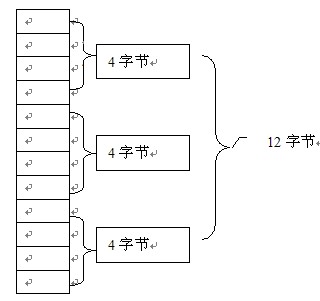
? ?让我们看看三个结构在内存中的布局:
? ?首先是 X1,如下图所示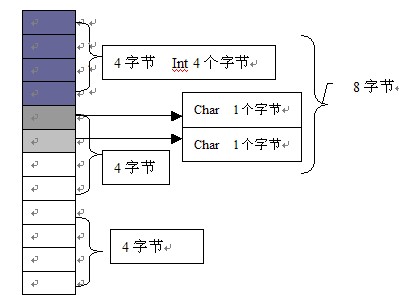
? ? X1 中第一个是 Int类型,它占有4字节,所以前面4格就是满了,然后第二个是char类型,这中类型只占一个字节,所以它占有了第二个4字节组块中的第一格,第三个也是char类型,所以它也占用一个字节,它就排在了第二个组块的第二格,因为它们加在一起大小也不超过一个块,所以他们三个变量在内存中的结构就是这样的,因为有内存分块对齐,所以最后出来的结果是8,而不是6,因为后面两个格子其实也算是被用了。
? ? 再次看看X2,如图所示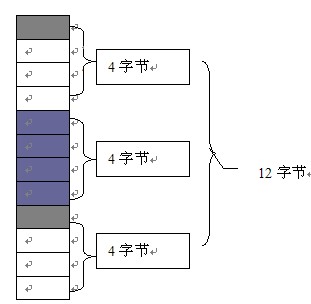
? ? X2中第一个类型是Char类型,它占用一个字节,所以它首先排在第一组块的第一个格子里面,第二个是Int类型,它占用4个字节,第一组块已经用掉一格,还剩3格,肯定是无法放下第二Int类型的,因为要考虑到对齐,所以不得不把它放到第二个组块,第三个类型是Char类型,跟第一个类似。所因为有内存分块对齐,我们的内存就不是8个格子了,而是12个了。
再看看X3,如下图所示: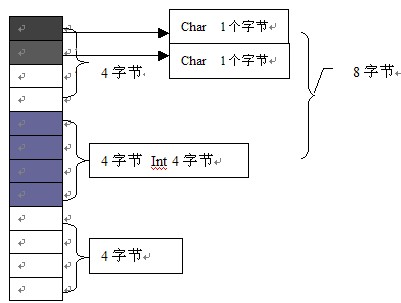
? ?关于X3的说明其实跟X1是类似的,只不过它把两个1个字节的放到了前面,相信看了前面两种情况的说明这里也是很容易理解的。What is the size of this structure in bytes? Many programmers will answer "6 bytes." It makes sense: one byte for?
Field TypeField NameField OffsetField SizeField Enda, four bytes forb?and another byte for?c. 1 + 4 + 1 equals 6. Here's how it would lay out in memory:chara011longb145charc516Total Size in Bytes:6However, if you were to ask your compiler to?
sizeof( Struct ), chances are the answer you'd get back would be greater than six, perhaps eight or even twenty-four. There's two reasons for this: backwards compatibility and efficiency.First, backwards compatibility. Remember the 68000 was a processor with two-byte memory access granularity, and would throw an exception upon encountering an odd address. If you were to read from or write to field?
b, you'd attempt to access an odd address. If a debugger weren't installed, the old Mac OS would throw up a System Error dialog box with one button: Restart. Yikes!So, instead of laying out your fields just the way you wrote them, the compiler?padded?the structure so that?
Field TypeField NameField OffsetField SizeField Endb?and?c?would reside at even addresses:chara011padding112longb246charc617padding718Total Size in Bytes:8Padding is the act of adding otherwise unused space to a structure to make fields line up in a desired way. Now, when the 68020 came out with built-in hardware support for unaligned memory access, this padding was unnecessary. However, it didn't hurt anything, and it even helped a little in performance.
The second reason is efficiency. Nowadays, on PowerPC machines, two-byte alignment is nice, but four-byte or eight-byte is better. You probably don't care anymore that the original 68000 choked on unaligned structures, but you probably care about potential 4,610% performance penalties, which can happen if a?
double?field doesn't sit aligned in a structure of your devising.很多人都知道是内存对齐所造成的原因,却鲜有人告诉你内存对齐的基本原理!上面作者就做了解释!
?
?
?
三??不懂内存对齐将造成的可能影响如下
- Your software may hit performance-killing unaligned memory access exceptions, which invoke?very?expensive alignment exception handlers.
- Your application may attempt to atomically store to an unaligned address, causing your application to lock up.
- Your application may attempt to pass an unaligned address to Altivec, resulting in Altivec reading from and/or writing to the wrong part of memory, silently corrupting data or yielding incorrect results.
四 ??? ? ? ? ?内存对齐规划
一、内存对齐的原因- 大部分的参考资料都是如是说的:
1、平台原因(移植原因):不是所有的硬件平台都能访问任意地址上的任意数据的;某些硬件平台只能在某些地址处取某些特定类型的数据,否则抛出硬件异常。
2、性能原因:数据结构(尤其是栈)应该尽可能地在自然边界上对齐。原因在于,为了访问未对齐的内存,处理器需要作两次内存访问;而对齐的内存访问仅需要一次访问。
?
二、对齐规则
每个特定平台上的编译器都有自己的默认“对齐系数”(也叫对齐模数)。程序员可以通过预编译命令#pragma pack(n),n=1,2,4,8,16来改变这一系数,其中的n就是你要指定的“对齐系数”。
规则:
1、数据成员对齐规则:结构(struct)(或联合(union))的数据成员,第一个数据成员放在offset为0的地方,以后每个数据成员的对齐按照#pragma pack指定的数值和这个数据成员
自身长度中,比较小的那个进行。
2、结构(或联合)的整体对齐规则:在数据成员完成各自对齐之后,结构(或联合)本身也要进行对齐,对齐将按照#pragma pack指定的数值和结构(或联合)最大数据成员长度中,比较小的那个进行。
3、结合1、2可推断:当#pragma pack的n值等于或超过所有数据成员长度的时候,这个n值的大小将不产生任何效果。
?
三、试验
下面我们通过一系列例子的详细说明来证明这个规则
编译器:GCC 3.4.2、VC6.0
平台:Windows XP
?
典型的struct对齐
struct定义:
#pragma pack(n) /* n = 1, 2, 4, 8, 16 */
struct test_t {
?int a;
?char b;
?short c;
?char d;
};
#pragma pack(n)
首先确认在试验平台上的各个类型的size,经验证两个编译器的输出均为:
sizeof(char) = 1
sizeof(short) = 2
sizeof(int) = 4
?
试验过程如下:通过#pragma pack(n)改变“对齐系数”,然后察看sizeof(struct test_t)的值。
?
1、1字节对齐(#pragma pack(1))
输出结果:sizeof(struct test_t) = 8 [两个编译器输出一致]
分析过程:
1) 成员数据对齐
#pragma pack(1)
struct test_t {
?int a;? /* 长度4 > 1 按1对齐;起始offset=0 0%1=0;存放位置区间[0,3] */
?char b;? /* 长度1 = 1 按1对齐;起始offset=4 4%1=0;存放位置区间[4] */
?short c; /* 长度2 > 1 按1对齐;起始offset=5 5%1=0;存放位置区间[5,6] */
?char d;? /* 长度1 = 1 按1对齐;起始offset=7 7%1=0;存放位置区间[7] */
};
#pragma pack()
成员总大小=8
?
2) 整体对齐
整体对齐系数 = min((max(int,short,char), 1) = 1
整体大小(size)=$(成员总大小) 按 $(整体对齐系数) 圆整 = 8 /* 8%1=0 */ [注1]
?
2、2字节对齐(#pragma pack(2))
输出结果:sizeof(struct test_t) = 10 [两个编译器输出一致]
分析过程:
1) 成员数据对齐
#pragma pack(2)
struct test_t {
?int a;? /* 长度4 > 2 按2对齐;起始offset=0 0%2=0;存放位置区间[0,3] */
?char b;? /* 长度1 < 2 按1对齐;起始offset=4 4%1=0;存放位置区间[4] */
?short c; /* 长度2 = 2 按2对齐;起始offset=6 6%2=0;存放位置区间[6,7] */
?char d;? /* 长度1 < 2 按1对齐;起始offset=8 8%1=0;存放位置区间[8] */
};
#pragma pack()
成员总大小=9
2) 整体对齐
整体对齐系数 = min((max(int,short,char), 2) = 2
整体大小(size)=$(成员总大小) 按 $(整体对齐系数) 圆整 = 10 /* 10%2=0 */
?
3、4字节对齐(#pragma pack(4))
输出结果:sizeof(struct test_t) = 12 [两个编译器输出一致]
分析过程:
1) 成员数据对齐
#pragma pack(4)
struct test_t {
?int a;? /* 长度4 = 4 按4对齐;起始offset=0 0%4=0;存放位置区间[0,3] */
?char b;? /* 长度1 < 4 按1对齐;起始offset=4 4%1=0;存放位置区间[4] */
?short c; /* 长度2 < 4 按2对齐;起始offset=6 6%2=0;存放位置区间[6,7] */
?char d;? /* 长度1 < 4 按1对齐;起始offset=8 8%1=0;存放位置区间[8] */
};
#pragma pack()
成员总大小=9
?
2) 整体对齐
整体对齐系数 = min((max(int,short,char), 4) = 4
整体大小(size)=$(成员总大小) 按 $(整体对齐系数) 圆整 = 12 /* 12%4=0 */
?
4、8字节对齐(#pragma pack(8))
输出结果:sizeof(struct test_t) = 12 [两个编译器输出一致]
分析过程:
1) 成员数据对齐
#pragma pack(8)
struct test_t {
?int a;? /* 长度4 < 8 按4对齐;起始offset=0 0%4=0;存放位置区间[0,3] */
?char b;? /* 长度1 < 8 按1对齐;起始offset=4 4%1=0;存放位置区间[4] */
?short c; /* 长度2 < 8 按2对齐;起始offset=6 6%2=0;存放位置区间[6,7] */
?char d;? /* 长度1 < 8 按1对齐;起始offset=8 8%1=0;存放位置区间[8] */
};
#pragma pack()
成员总大小=9
2) 整体对齐
整体对齐系数 = min((max(int,short,char), 8) = 4
整体大小(size)=$(成员总大小) 按 $(整体对齐系数) 圆整 = 12 /* 12%4=0 */
?
5、16字节对齐(#pragma pack(16))
输出结果:sizeof(struct test_t) = 12 [两个编译器输出一致]
分析过程:
1) 成员数据对齐
#pragma pack(16)
struct test_t {
?int a;? /* 长度4 < 16 按4对齐;起始offset=0 0%4=0;存放位置区间[0,3] */
?char b;? /* 长度1 < 16 按1对齐;起始offset=4 4%1=0;存放位置区间[4] */
?short c; /* 长度2 < 16 按2对齐;起始offset=6 6%2=0;存放位置区间[6,7] */
?char d;? /* 长度1 < 16 按1对齐;起始offset=8 8%1=0;存放位置区间[8] */
};
#pragma pack()
成员总大小=9
?
2) 整体对齐
整体对齐系数 = min((max(int,short,char), 16) = 4
整体大小(size)=$(成员总大小) 按 $(整体对齐系数) 圆整 = 12 /* 12%4=0 */
8字节和16字节对齐试验证明了“规则”的第3点:“当#pragma pack的n值等于或超过所有数据成员长度的时候,这个n值的大小将不产生任何效果”。
?
内存分配与内存对齐是个很复杂的东西,不但与具体实现密切相关,而且在不同的操作系统,编译器或硬件平台上规则也不尽相同,虽然目前大多数系统/语言都具有自动管理、分配并隐藏低层操作的功能,使得应用程序编写大为简单,程序员不在需要考虑详细的内存分配问题。但是,在系统或驱动级以至于高实时,高保密性的程序开发过程中,程序内存分配问题仍旧是保证整个程序稳定,安全,高效的基础。 [注1]
什么是“圆整”?
举例说明:如上面的8字节对齐中的“整体对齐”,整体大小=9?按?4?圆整?= 12
圆整的过程:从9开始每次加一,看是否能被4整除,这里9,10,11均不能被4整除,到12时可以,则圆整结束。
五??作者
Jonathan Rentzsch http://www.ibm.com/developerworks/library/pa-dalign/http://www.cppblog.com/cc/archive/2006/08/01/10765.html(中文优秀解释)http://www.cppblog.com/snailcong/archive/2009/03/16/76705.html(对英文版的消化,可以查看该博客)http://blogold.chinaunix.net/u3/118340/showart_2615855.html
