POJ1328 区间选点问题(贪心)
以下内容复制于http://blog.csdn.net/dgq8211/article/details/7534776
先来看看什么是区间选点问题
数轴上有n个闭区间[ai,bi]。取尽量少的点,使得每个区间内都至少有一个点(不同区间内含的点可以是同一个)。
贪心策略:
按照b1<=b2<=b3…(b相同时按a从大到小)的方式排序排序,从前向后遍历,当遇到没有加入集合的区间时,选取这个区间的右端点b。
证明:
为了方便起见,如果区间i内已经有一个点被取到,我们称区间i被满足。
1、首先考虑区间包含的情况,当小区间被满足时大区间一定被满足。所以我们应当优先选取小区间中的点,从而使大区间不用考虑。
按照上面的方式排序后,如果出现区间包含的情况,小区间一定在大区间前面。所以此情况下我们会优先选择小区间。
则此情况下,贪心策略是正确的。
2、排除情况1后,一定有a1<=a2<=a3……。

对于区间1来说,显然选择它的右端点是明智的。因为它比前面的点能覆盖更大的范围。
从而此情况下,贪心策略也是正确的。
Radar InstallationAssume the coasting is an infinite straight line. Land is in one side of coasting, sea in the other. Each small island is a point locating in the sea side. And any radar installation, locating on the coasting, can only cover d distance, so an island in the sea can be covered by a radius installation, if the distance between them is at most d.
We use Cartesian coordinate system, defining the coasting is the x-axis. The sea side is above x-axis, and the land side below. Given the position of each island in the sea, and given the distance of the coverage of the radar installation, your task is to write a program to find the minimal number of radar installations to cover all the islands. Note that the position of an island is represented by its x-y coordinates.
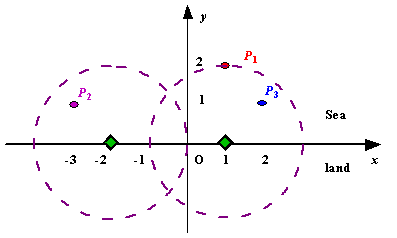
Figure A Sample Input of Radar Installations
The input consists of several test cases. The first line of each case contains two integers n (1<=n<=1000) and d, where n is the number of islands in the sea and d is the distance of coverage of the radar installation. This is followed by n lines each containing two integers representing the coordinate of the position of each island. Then a blank line follows to separate the cases.
The input is terminated by a line containing pair of zeros
For each test case output one line consisting of the test case number followed by the minimal number of radar installations needed. "-1" installation means no solution for that case.
Beijing 2002
题目的意思就是给你一个坐标轴,雷达在x轴上,岛屿分布在x轴上方,给你岛屿的坐标以及雷达的最大扫描面积,求最少用几个雷达可以将所有的岛屿覆盖!
思路:
以岛为圆心,以d为半径画圆(d是雷达的辐射半径),其与x轴相交的区间为一个区 这样就变成了在区间内找最少的点问题了
#include<iostream>#include<cmath>using namespace std;typedef struct{double l,r;}in;int cmp(const void *a, const void *b){return (*(in *)a).l >= (*(in *)b).l ? 1:-1;}int main(){int n,d,i,x,y,sw,re,count = 1;double pre;in p[1000];while(1){cin>>n>>d;if(n == 0 && d==0) break;sw = 1;for(i=0;i<n;i++){cin>>x>>y;if(d>=y&&sw==1){p[i].l = x-sqrt((double)d*d - (double)y*y);p[i].r = x+sqrt((double)d*d - (double)y*y);}else{sw = 0;}}if(sw == 0){cout<<"Case "<<count++<<": "<<-1<<endl;continue;}qsort(p,n,sizeof(in),cmp); re = 1;pre = p[0].r;for(i=1;i<n;i++){if(p[i].l>pre){re++;pre = p[i].r;}else{if(p[i].r<pre){pre = p[i].r;}}}cout<<"Case "<<count++<<": "<<re<<endl;}return 0;}
